Loader

BLOCKCHAIN APP DEVELOPMENT SERVICES

Blockchain Application Development Services

Triazine Software builds blockchain applications for problems where several organisations need to share one record they can all trust: supply chain provenance, multi-party settlement, tamper-proof audit trails, digital credentials and tokenised assets. We start by checking whether blockchain is the right tool, then design the smart contracts, network and integrations with your ERP, SAP and operational systems, with security review before anything is deployed. You own the code, the contracts and the keys.

Blockchain is useful for a specific kind of problem: several organisations need to share a record, none of them should be able to change it alone, and everyone needs to verify it without trusting a single owner. Supply chains with many handovers, settlements between partners, compliance records regulators must trust, and credentials that must be verified anywhere fit that shape. Many other problems do not, and a normal database would be faster and cheaper. As a blockchain development company focused on enterprises, we tell you which kind of problem you have before we design anything, then build blockchain applications that connect to the systems you already run. We work with clients across the US, UK, UAE, Australia, South Africa and India.

Enterprises that trust Triazine

Tony Elumelu Foundation Domino's Pizza Indraprastha Gas Limited Aavantika Gas Limited Godfrey Phillips India Ministry of Defence India Toyota Boshoku Schindler University of Cambridge Crompton NTPC Sound Royalties

What Is Blockchain Application Development?

A database stores records. A blockchain stores records that every authorised participant can verify independently, that are immutable once written, and that execute predefined logic automatically through smart contracts. The difference matters most in situations where trust between parties is the core problem - a supply chain where multiple companies need to verify product provenance, a financial process where settlement needs to be instantaneous and auditable, or a compliance record that must be tamper-evident by design.

That is the difference between a good blockchain project and applying distributed ledger technology to a problem a standard database already handles well. Blockchain adds real value when the use case specifically requires shared trust, immutability, or automated contract execution across multiple parties - and adds unnecessary complexity where that requirement is absent.

We start every engagement by validating the fit between blockchain's actual capabilities and your specific problem, then build the application - smart contracts, integration layer, and user interface - around your operational requirements rather than a generic template.


Business Outcomes

Immutable Records Your Auditors Can Verify Independently

Immutable Records Your Auditors Can Verify Independently

Every transaction written to the blockchain is permanent, timestamped, and verifiable by every authorised participant - giving compliance and audit teams a tamper-evident record that eliminates manual reconciliation.

Smart Contract Automation, Removing Manual Intermediaries

Smart Contract Automation, Removing Manual Intermediaries

Business rules encoded in smart contracts execute automatically when defined conditions are met - removing the manual intermediary steps that slow settlement, approval, and fulfilment processes.

Supply Chain Transparency Across Every Party

Supply Chain Transparency Across Every Party

A shared blockchain ledger gives every participant in a supply chain - manufacturer, distributor, retailer, regulator - the same verified view of product provenance and movement, eliminating conflicting records across parties.

Reduced Settlement and Reconciliation Time

Reduced Settlement and Reconciliation Time

Blockchain-based financial and operational processes settle against a shared, authoritative record, removing the reconciliation cycles that consume time and resources in multi-party processes today.

Do You Need Blockchain or a Database?

The most valuable decision in a blockchain project is whether to use blockchain at all. This is the check we run first.

What you need Better with a database Better with blockchain
One organisation controls the data Yes No
Several organisations must share one record and trust it Hard to achieve Yes
Records must never change, even by an administrator Only with extra controls Yes, by design
Very high-speed, high-volume private transactions Yes Only on specialised networks
Business rules must run automatically across parties Possible, with one party in control Yes, through smart contracts
Personal data must be deleted on request Yes Keep it off-chain and store only proofs on-chain
Anyone, anywhere must verify a credential or claim Needs a central service Yes

Blockchain is a good fit when

  • Several companies, agencies or partners must share and verify the same records
  • No single party should be able to change history alone
  • Reconciliation between parties takes days and causes disputes
  • Regulators, auditors or customers need proof that records were not altered
  • Value, rights or credentials must move between parties without a central intermediary

Blockchain is not a good fit when

  • One organisation owns and controls all the data
  • The main need is speed and volume inside one company
  • Data must be edited or deleted freely; store it off-chain if blockchain is still needed for proofs

Our Blockchain App Development Services

Custom Blockchain Development

End-to-end blockchain development - from use case validation and architecture through smart contract development, integration, and deployment - built around your specific operational requirements rather than a generic distributed ledger template.

Smart Contract Development & Audit

Writing, testing, and auditing smart contracts that execute business logic automatically and securely on-chain - covering ERC standards, custom logic, and third-party audit to ensure contracts behave exactly as intended before deployment.

Supply Chain & Provenance Tracking

Blockchain for supply chain transparency - recording product origin, movement, and custody changes on a shared, immutable ledger accessible to every authorised participant across your supply chain.

Tokenisation & Digital Asset Development

Developing tokenised asset platforms - securities, loyalty points, real-world assets - on enterprise-grade blockchain infrastructure, with the compliance and custody considerations enterprise tokenisation requires.

Private & Permissioned Blockchain Networks

Designing and deploying permissioned blockchain networks for enterprise consortia, where participants require controlled access and governance rather than a fully public chain.

Blockchain Development Consulting

Structured blockchain development consulting engagements - validating whether blockchain fits your specific problem, selecting the right platform, and designing the architecture before a line of code is written.

Blockchain Integration with ERP/CRM/EHS/OPS

Connecting blockchain applications to the ERP, CRM, EHS, and operational systems you already run - so on-chain events trigger off-chain actions and vice versa, keeping every system in sync.

Blockchain Support and Lifecycle Management

Go-live is the starting point, with ongoing support carrying performance forward. We monitor smart contract performance, network health, and evolving business requirements on every deployed application.

dApp Front Ends and Wallet Integration

Web and mobile front ends that make blockchain applications usable by people who do not care about blockchain: wallet connection or custodial accounts, clear transaction states, readable errors and gas fees handled or sponsored where the use case allows.

Digital Identity and Verifiable Credentials

Tamper-proof certificates, licences, KYC results and permits issued as verifiable credentials, so any authorised party can confirm they are genuine and still valid without calling the issuer, while personal data stays off-chain.

Oracles, Layer 2 Scaling and Interoperability

Bringing trusted real-world data on-chain through oracles, cutting fees and increasing throughput with Layer 2 networks, and connecting chains and systems so assets and data move where they are needed.

Ways to Start With Blockchain

01

Blockchain fit assessment

Best as the first step. A short, fixed-scope review of your use case against the blockchain vs database test, with a recommendation, platform options and a proof-of-concept plan, or a clear "use a database" if that is the answer.

02

Proof of concept

Best for testing a promising use case. A working prototype with core smart contracts on a test network, used by real participants, to prove value before a larger investment.

03

MVP and production build

Best once the proof of concept has shown value. Production smart contracts with security review, network set-up, front ends and integration with your ERP, SAP and operational systems.

04

Dedicated blockchain team and support

Best for long-running platforms. Blockchain, integration and security engineers work as an extension of your team, and we support the network and contracts after go-live. See hire software engineers and IT support and maintenance.

Our Blockchain Application Development Process

A proof of concept usually takes 4 to 8 weeks; a production blockchain application usually takes 4 to 9 months, depending on contracts, participants and integrations.

  1. Use case validation

    Assess whether blockchain genuinely fits the problem, and identify where it adds value a centralised system already handles well.

    Typical duration: 1-2 weeks

  2. Architecture design

    Select the right blockchain platform and design the application architecture, smart contract structure, and integration layer.

    Typical duration: 2-3 weeks

  3. Smart contract development

    Write and test smart contracts encoding your specific business logic and execution conditions.

    Typical duration: 3-8 weeks

  4. Security audit

    Conduct a thorough audit of smart contract code before deployment, identifying vulnerabilities before they reach production.

    Typical duration: 2-4 weeks, depending on contract size and audit scope

  5. Integration

    Connect the blockchain application to your existing ERP, CRM, EHS, and operational systems.

    Typical duration: inside development sprints

  6. Testing & validation

    Validate application behaviour across real-world scenarios and edge cases before production deployment.

    Typical duration: 2-3 weeks on a test network

  7. Pilot deploy

    Release into production on a limited, closely monitored scope - real transactions, real participants, contained blast radius.

    Typical duration: 4-8 weeks with real participants

  8. Full deploy

    Move from pilot to mainnet at full scale once smart contract performance holds up - every transaction, every participant, fully in production.

    Typical duration: phased by participant group

  9. Monitoring

    Track smart contract performance, network health, and usage on an ongoing basis, feeding what's learned back into use case validation.

    Typical duration: ongoing

Use Case First, Audited Code, Human-Owned Keys

We use automated analysis and AI-assisted tools to write and test smart contracts faster, not to replace the engineers accountable for code that is hard to change once it is deployed. Our engineers stay responsible for the use case, contract logic, security review, key management and integration, and your organisation keeps control of governance and every key. Every use case is validated before design, every contract is reviewed before deployment, every upgrade path and emergency control is agreed with you, and the code, contracts and keys stay fully owned by you.

01

The right tool, or no blockchain at all

Every engagement starts with the blockchain vs database test, so you only invest in blockchain where shared trust and immutability are genuinely needed.

02

Reviewed before it is irreversible

Contracts go through testing, automated analysis and manual review, and third-party audit where the value at risk calls for it, before they touch a live network.

03

Upgrade and emergency controls agreed up front

Upgradeable contract patterns, pause functions and multi-signature approvals are designed with your governance team, so mistakes can be contained without breaking trust.

04

Your keys, your governance

Admin and treasury keys sit with your organisation in hardware wallets, multi-signature setups or a custody provider you choose, never with us alone.

Public, Private, Consortium and Hybrid Blockchains

Public Private Consortium Hybrid
Who can join Anyone One organisation's approved users Approved members of a group Private network with selected public proofs
Who validates transactions Open network of validators The owning organisation Member organisations Members, with checkpoints on a public chain
Privacy Transparent by default High High, shared among members High, with public verifiability
Typical use Tokens, public credentials, open settlement Internal audit trails Supply chains, trade and settlement between partners Enterprise records with public proof of integrity

Choosing a Blockchain Platform

We are platform-neutral and choose per use case.

Platform Type Contract language Strengths Often the best fit for
Ethereum Public Solidity Largest ecosystem and security track record High-value tokens and settlement
Polygon Public, Ethereum-compatible scaling Solidity Low fees, Ethereum compatibility Consumer-scale apps, loyalty and credentials
Hyperledger Fabric Permissioned Go, Java, JavaScript Private channels, fine-grained permissions Enterprise consortia and supply chains
Hyperledger Besu Permissioned or public Ethereum client Solidity Private Ethereum networks with enterprise controls Ethereum-compatible private networks
Solana Public Rust Very high throughput, low fees High-volume payments and real-time apps
Avalanche Public with custom subnets Solidity App-specific chains with their own rules Networks needing custom validator rules

Technology Stack & Platforms

We deliver blockchain app development services on enterprise-proven distributed ledger and smart contract platforms - backed by infrastructure and delivery discipline proven across 11+ years of mission-critical software delivery.

Ethereum

Polygon

Hyperledger Fabric

Hyperledger Besu

Solana

Avalanche

Solidity

Rust

Go

Hardhat

Foundry

OpenZeppelin

Ethers.js

Web3.js

MetaMask

WalletConnect

The Graph

IPFS

Arweave

Chainlink

Alchemy

Infura

AWS

Azure

REST APIs

SAP

Smart Contract Security, Key Management and Regulation

Blockchain mistakes are public and often permanent. These controls are part of every engagement. We build applications that support your regulatory obligations; legal advice and certification of your own organisation stay with your advisers and auditors.

01

Layered smart contract review

Unit and integration tests, automated static analysis, fuzz testing and manual line-by-line review, followed by an independent third-party audit when the value or risk warrants it.

02

Known attack patterns covered

Contracts are checked against common vulnerabilities such as reentrancy, access-control mistakes, integer and rounding errors, front-running and oracle manipulation, using well-tested OpenZeppelin components wherever possible.

03

Key management and custody

Keys are held in hardware wallets, multi-signature setups or a regulated custody provider, with clear roles for who can approve what, and documented recovery procedures.

04

Personal data stays off-chain

Personal and sensitive data is stored off-chain with only hashes or proofs on-chain, so you can meet data deletion and privacy duties under GDPR, India's DPDP Act and similar laws.

05

Regulatory awareness for tokens

Tokenisation projects are designed with securities, KYC and anti-money-laundering requirements in mind, such as US securities rules and the EU's MiCA regulation, working alongside your legal advisers.

06

Process standards and IP protection

CMMI Level 3 delivery governance and ISO 9001:2015 quality management standards. Your use case and code are protected by our Non-Disclosure Agreement, and every contract, script and key belongs to you.

What Clients Say About Working With Triazine

"We weren't looking for a traditional vendor. We wanted a true technology partner who could integrate with our team, understand our creators, and share our vision. Feels like one unified team collaborating across continents."

Chip Correra

Fractional CTO, Sound Royalties (United States)

"Working with Triazine Software was an excellent experience. Their flexibility, responsiveness, and problem-solving expertise delivered every requirement, improved our app store ratings, enhanced customer experience... and significantly reduced the cost of resolving customer complaints."

Anadi Mishra

Chief General Manager, Indraprastha Gas Limited (India)

"Triazine Software was recommended by IBM for our Pizza Online Ordering mobile app and the team stood up to our expectation... I highly recommend Triazine Software as dependable development partner for organization like us."

Sudhir Kumar Singh

Technical Program Manager, Domino's Pizza (India)

"Triazine delivered high-quality work on time, transforming our vision into a successful hybrid app. Their patience, responsiveness, flexibility across time zones, and commitment to implementing every feedback ensured outstanding results."

Roger Yarrow

CEO, TrueLook (United States)

"Triazine Software transformed Ticketkore with a powerful smart ticketing and reservation platform."

Khomotjo R. Lebepe

CEO, Ticketkore (South Africa)

Why Choose Triazine as Your Blockchain Development Company?

Triazine Software helps enterprises move from blockchain experimentation to production applications that solve a real business problem. Our approach combines proven distributed ledger expertise with the integration depth and domain knowledge complex enterprise deployments require.

01

Use Case Validation Before Architecture, Every Time

We test whether blockchain genuinely fits your problem before choosing a platform or writing a contract, so every project is justified by a real business need.

02

Smart Contracts Built for Reliability, Audited Before Deployment

Every smart contract is written, tested, and independently audited before deployment - so logic executes exactly as intended from the first real transaction.

03

Custom Blockchain Development, From Private to Public Chains

We design and deploy on permissioned enterprise networks and public chains, matching the architecture to the governance and trust your use case actually needs.

04

Full Integration With Systems You Already Run

We connect blockchain applications directly to your ERP, SAP, CRM, EHS and operations platforms, so on-chain events trigger real business actions and every system stays in sync.

05

Delivery Discipline That Scales With Complexity

CMMI Level 3 delivery brings the same documentation, review and testing rigour to every engagement, whatever the chain or the number of participants.

06

One Partner From Assessment Through Support

Assessment, build, integration, security review and ongoing support from one team, so knowledge of your contracts and network is never lost between vendors.

07

Honest About When Not to Use Blockchain

If a database, an API or a shared portal solves your problem better, we will say so, and we can build that instead. You only pay for blockchain where it adds value.

Who You Will Work With and Where We Are

Triazine Software was founded in 2015 by Abhinav Kumar and Vikash Srivastava to help enterprises replace fragmented systems and manual workarounds with platforms that run with clarity, governance and accountability. Abhinav, Co-Founder and Director, brings over two decades of enterprise software engineering experience and leads technology direction and delivery. Vikash, Co-Founder and Director, leads operations, client success and strategic partnerships.

Your blockchain team

Blockchain consultants who run the fit assessment and design the network and governance

Smart contract engineers who write and test contracts

Security engineers who run automated analysis and manual review

Integration and front-end engineers who connect the application to your systems and users

Meet the leadership and core team

Contact and locations

USA: Triazine Software LLC, 8 The Green, Ste A, Dover, DE 19901. +1 (347) 941-1655

India: Triazine Software Pvt. Ltd., B-28 & 29, Sector 58, Noida 201301. +91-120 4275378

Email: sales@triazinesoft.com

Serving enterprises across North America, Europe, the Middle East, Africa and Asia Pacific.

Frequently Asked Questions

Blockchain application development is designing and building software that records data or runs business rules on a blockchain, a shared ledger that several parties can verify and none can change alone. It includes smart contracts, the network, front ends and integration with existing systems.

A typical engagement covers use-case validation, platform and network design, smart contract development, security review and audit, front ends and wallets, integration with ERP, SAP and other systems, testing, deployment and ongoing support.

When several organisations must share one record they all trust, no single party should be able to change it, and disputes or reconciliation are costly. If one organisation controls the data, a normal database is usually better.

Public blockchains are open to anyone. Private blockchains are run by one organisation for its approved users. Consortium blockchains are shared and governed by a group of organisations, which is often the best fit for supply chains and partner networks.

It depends on privacy, speed, cost and who needs to participate. Hyperledger Fabric or Besu suit private consortia; Ethereum suits high-value public assets; Polygon and Solana suit low-fee, high-volume use. We recommend after the fit assessment.

A smart contract is code on a blockchain that runs business rules automatically when agreed conditions are met, such as releasing a payment when a delivery is confirmed, with the result recorded where every party can see it.

Through tests, automated static analysis, fuzz testing and manual review against known attack patterns, using well-tested OpenZeppelin components, followed by an independent third-party audit when the value at risk warrants it.

Deployed code cannot be edited directly, but contracts can be designed with agreed upgrade patterns, pause functions and multi-signature controls, so issues can be fixed or contained under your governance rules.

Yes. We connect blockchain applications to ERP, SAP, CRM and EHS systems through APIs and event listeners, so on-chain events update business systems and business events can trigger on-chain actions.

A fit assessment takes one to two weeks, a proof of concept usually 4 to 8 weeks, and a production application 4 to 9 months, depending on the number of contracts, participants and integrations.

Personal data is kept off-chain in a system that supports deletion, and only hashes or proofs are written on-chain, so records stay verifiable while privacy and deletion rights are respected.

Yes. We build platforms for tokenised assets, loyalty points and digital credentials, designed with KYC, anti-money-laundering and securities requirements in mind and alongside your legal advisers.

Look for an honest fit assessment rather than a sales pitch, a clear smart contract security process, experience integrating with enterprise systems, and full ownership of code and keys. Ask how they will contain a contract bug after deployment.

You do. Smart contract code, front ends, integrations and documentation belong to you, and admin keys are held by your organisation or a custody provider you choose.

Yes. Triazine Software LLC is registered in Dover, Delaware, and you can reach the US team on +1 (347) 941-1655 or sales@triazinesoft.com. Delivery is run from our Noida, India centre with US clients such as Sound Royalties and TrueLook.

Get a Free Blockchain Fit Assessment

Tell us the problem you think blockchain might solve. We will respond within 24 hours to set up a short session, and you will leave with an honest answer on whether blockchain fits, the platform options if it does, and a proof-of-concept plan. Your use case is protected by our Non-Disclosure Agreement.

Request an Assessment

Prefer to talk? US: +1 (347) 941-1655 | India: +91-120 4275378 | sales@triazinesoft.com

Proven Excellence

Trusted by Enterprise Operations.

  • 11+ yrs — Enterprise delivery
  • CMMI L3 — Certified process
  • 100% — Code, contract & key ownership

See Blockchain Use Cases

500+ Solutions & platforms
12.9M+ Multi-party sales transactions reconciled on one platform we built (GPI)
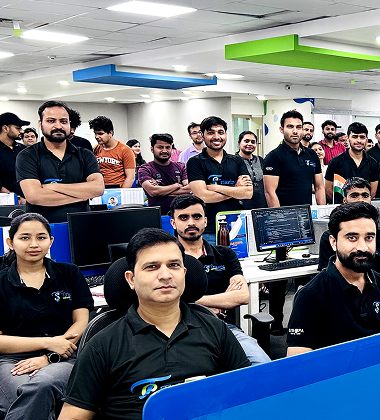
Triazine team
54 Countries on an audit-logged platform we built (TEFConnect)
CMMI L3 Certified process