Loader

CLOUD MIGRATION SERVICES

Cloud Migration Services and Cloud-Native Development

Triazine Software moves enterprise applications, databases and business systems to AWS, Azure and Google Cloud, choosing the right approach for each workload, migrating in phases without downtime, and building cloud-native applications that scale and cost what they should. You own every cloud account, script and line of code, and delivery follows CMMI Level 3 discipline.

Most enterprises are somewhere in the middle of the cloud: a few workloads moved, many still on-premise, some moved but never optimised, and a cloud bill that keeps growing. The risk is not the move itself; it is moving everything the same way, discovering dependencies on cutover night, and carrying old problems into a more expensive environment. Our cloud migration services start with an assessment of every workload, pick the right migration approach for each, move them in rehearsed phases with a tested way back, and leave you with an environment that is secure, observable and right-sized. We deliver for clients across the US, UK, UAE, Australia, South Africa and India.

Trusted by the Tony Elumelu Foundation, Domino's Pizza, IGL, Aavantika Gas, Godfrey Phillips, Ministry of Defence, Schindler, University of Cambridge and other enterprises worldwide

Tony Elumelu Foundation Domino's Pizza Indraprastha Gas Limited Aavantika Gas Limited Godfrey Phillips India Ministry of Defence India Toyota Boshoku Schindler University of Cambridge Crompton NTPC Sound Royalties

What Are Cloud Migration Services?

Moving a server to a cloud provider is infrastructure management. Cloud migration services go considerably further - assessing your existing workloads, designing the target architecture, re-architecting applications to take genuine advantage of cloud-native capability, and migrating data and systems in a sequence that minimises disruption to live operations.

The right approach depends on each workload: some should move quickly as they are, some need a platform upgrade on the way, and some are worth re-architecting for cloud-native scale. A lift-and-shift moves an application to cloud infrastructure while leaving its underlying architecture unchanged - the same technical debt, the same performance limitations, now running on infrastructure billed by the hour. Cloud development solutions built for enterprise scale start from the application's actual requirements and redesign the architecture around cloud-native services - autoscaling, managed databases, serverless compute, and distributed resilience - so the application performs and costs differently on cloud infrastructure than it did on-premises.

It's built to make cloud infrastructure work considerably harder for your business - new capability and operational resilience that legacy infrastructure was unable to support.


Business Outcomes

Lower Infrastructure Cost Through Right-Sized Architecture

Lower Infrastructure Cost Through Right-Sized Architecture

Cloud-native architecture scales resources to actual demand rather than peak capacity, so infrastructure costs reflect what your workloads genuinely need rather than what a fixed server was provisioned to handle.

Improved Resilience and Availability

Improved Resilience and Availability

Distributed cloud architecture eliminates single points of failure that on-premises infrastructure carries by design - services stay available as individual components fail, keeping the whole system running.

Faster Development and Deployment Cycles

Faster Development and Deployment Cycles

Cloud-native development services reduce the infrastructure management overhead that slows delivery teams, so engineers redirect time from managing servers toward building capability.

A Platform That Scales With Demand

A Platform That Scales With Demand

Cloud software development services are architected for elasticity from the start - handling traffic spikes, seasonal peaks, and growing user volume automatically, ahead of manual intervention or infrastructure procurement cycles.

The 7 Rs of Cloud Migration: Choosing the Right Approach for Each Workload

There is no single right way to move to the cloud. The assessment assigns one of these seven approaches to every application, so effort goes where it pays back.

Approach What happens Speed Cloud benefit Choose it when
Rehost (lift and shift) Moved as is to cloud servers Fastest Low at first A data-centre exit deadline is close; optimise later
Relocate Moved at the platform level, such as VMware to VMware on the cloud Fast Low to medium You run large VMware estates and need to move them together
Replatform Small changes on the way, such as a managed database or containers Fast Medium The application is sound but its runtime or database is not
Refactor or re-architect Redesigned as cloud-native services, containers or serverless Slower High Scale, resilience or release speed matter most
Repurchase Replaced by a SaaS product Medium High for that function A packaged product now covers the need
Retain Kept on-premise for now None None Latency, regulation or recent investment make moving premature
Retire Switched off Fast Saves cost The application is no longer used

Rehosting alone usually carries the same technical debt to a more expensive environment, so we plan the optimisation that follows it. For applications that need deeper rework, see our legacy application modernization service.

You are ready for cloud migration when

  • Data-centre, hardware or licence renewals are coming up
  • Systems struggle at peak load and cannot scale without buying more hardware
  • Disaster recovery is weak or untested
  • New features are slowed by provisioning servers and environments by hand
  • Teams in several regions need the same systems with good performance
  • You want cloud data, AI or analytics services your current setup cannot use

Migration is not the first step when

  • Nobody knows which applications depend on which; start with the assessment
  • The application is due to be replaced within a year
  • Regulation requires data to stay on-premise with no compliant cloud region available

Our Cloud Migration and Cloud Development Services

Cloud Migration Strategy & Assessment

A structured assessment of your existing workloads, architecture, and integration dependencies - resulting in a prioritised cloud migration strategy that sequences migration by risk, business impact, and technical complexity.

Cloud Infrastructure Migration

Migrating on-premises workloads to cloud infrastructure using the right approach for each workload, from rehost to full re-architecture, so applications are built to take advantage of cloud-native capability after migration.

Database and Data Migration

SQL Server, MySQL, PostgreSQL, Oracle and NoSQL databases, file stores and data warehouses moved to managed cloud databases and storage, with continuous replication during migration, record-level reconciliation against the source and a short, planned cutover window.

ERP, SAP and Business System Migration

Business-critical systems moved with their integrations intact: ERP, CRM, SAP-integrated portals, document management and BI platforms, with data cleansing before the move and end-to-end testing of every integration after it. See our SAP implementation and support team.

Cloud Cost Optimisation and FinOps

Right-sizing, auto-scaling, reserved and savings plans, scheduling non-production environments, storage tiering and cost reporting by team and application, so cloud spend tracks real usage. Ongoing optimisation continues through our cloud managed services.

Cloud-Native Application Development

Custom applications architected for cloud infrastructure from the ground up - built using managed services, serverless compute, and distributed architecture for the elasticity and resilience cloud platforms deliver.

Cloud-Hosted Web Applications

Web applications designed and deployed on cloud infrastructure, taking advantage of global content delivery, auto-scaling, and managed backend services for performance and availability at enterprise scale.

Multi-Cloud & Hybrid Cloud Architecture

Designing architectures that span multiple cloud providers or combine cloud and on-premises infrastructure - matching workload placement to cost, compliance, latency, and governance requirements.

Cloud Development & Migration Lifecycle Management

Go-live is the starting point, with ongoing optimisation carrying performance forward. We monitor cost, performance, security, and evolving workload requirements on every deployed cloud environment, refining as usage and business needs grow.

Ways to Work With Us on Cloud Migration

01

Cloud migration assessment

Best as the first step. A fixed-scope review of your applications, dependencies, data and infrastructure, ending with the right R for every workload, a migration sequence and a target architecture.

02

Migration project

Best when the plan is clear. We migrate workloads in waves, from a pilot to full cutover, and hand over a documented, secure and monitored environment.

03

Cloud-native development

Best for new products or rebuilt applications. We design and build applications on managed services, containers and serverless from the start.

04

Managed cloud after migration

Best when you want ongoing operations. We monitor, secure and optimise your cloud environment under defined SLAs. See cloud managed services and hire cloud and DevOps engineers.

Our Cloud Migration Process

Most single applications move in 4 to 12 weeks after assessment; larger portfolios move in waves over several months.

  1. Assessment & strategy

    Evaluate existing workloads, dependencies, and technical debt, and define the cloud migration strategy and sequencing.

    Typical duration: 2-4 weeks, including dependency mapping and the R for every workload

  2. Architecture design

    Design the target cloud architecture around your actual workloads, integrations, and performance requirements.

    Typical duration: 2-3 weeks, including landing zone and security design

  3. Migration planning

    Sequence the migration by risk and business impact, defining rollback procedures for each workload.

    Typical duration: 1-2 weeks, with rollback defined per workload

  4. Re-architecture or build

    Re-architect existing applications for cloud-native capability, or build new cloud development solutions from the ground up.

    Typical duration: varies by workload

  5. Data migration

    Migrate data to cloud storage and databases with validation against source systems throughout.

    Typical duration: continuous replication with record-level reconciliation

  6. Testing & validation

    Validate performance, resilience, and security against real workload scenarios before production cutover.

    Typical duration: 1-3 weeks per wave

  7. Pilot deploy

    Migrate a limited, closely monitored workload to production first - real traffic, real data, contained blast radius.

    Typical duration: 2-4 weeks on a low-risk workload

  8. Full migration

    Migrate every remaining workload to the cloud once pilot performance holds up - full traffic, full data, production cutover complete.

    Typical duration: in waves, each with its own cutover window

  9. Monitoring & optimisation

    Track cost, performance, and security on an ongoing basis, feeding what's learned back into assessment and strategy.

    Typical duration: ongoing

Zero-Downtime Migration, Human-Owned Cutovers

We use automation and proven migration patterns to move workloads quickly, not to take control of the cutover away from the people who run your business. Our architects stay responsible for the target architecture, sequencing, data integrity, security and rollback, and your teams decide when each workload switches over. Every migration is rehearsed, data is reconciled before cutover, rollback is tested, and the cloud environment, code and accounts stay fully owned by you.

01

Rehearsed before it happens

Each wave is dry-run in a non-production environment first, so dependencies, timings and surprises are found in rehearsal, not on cutover night.

02

Parallel run and phased cutover

Old and new environments run side by side while traffic moves across in stages, so users keep working and any issue affects a small share of traffic.

03

Data reconciled record by record

Databases replicate continuously during migration and are reconciled against the source before cutover, so nothing is lost or duplicated.

04

Rollback tested, not assumed

Every workload has a documented, tested way back to the original environment until the new one has proven itself in production.

Technology Stack Platforms

We are platform-neutral and recommend the cloud that fits your workloads, skills and existing agreements, or a combination of them.

Azure Migrate

AWS Migration Hub

AWS DMS

Google Migrate

Terraform

Pulumi

Ansible

Bicep & ARM

Docker

Kubernetes

GKE

AWS Lambda

Azure Functions

Google Cloud Run

Azure DevOps

GitHub Actions

Jenkins

Microsoft Entra ID

AWS IAM

HashiCorp Vault

Defender for Cloud

Datadog

Amazon CloudWatch

Azure Monitor

Grafana

Azure Cost Management

AWS Cost Explorer

Cloudflare

Amazon CloudFront

In production for our clients: .NET microservices in Docker and Kubernetes on Azure with Azure MySQL read replicas and an Azure Fabric data warehouse (TEFConnect); auto-scaling AWS infrastructure at 15,000+ concurrent users (Domino's); Angular, Django and MySQL on AWS for 2M+ customers (IGL Connect); and real-time SAP integration on cloud infrastructure (AGL Connect).

Cloud Security, Business Continuity and Governance

A migrated workload should be safer than it was on-premise. These controls are part of every landing zone we build. We build environments that support your regulatory obligations; certification of your own organisation stays with you and your auditor.

01

Secure landing zone and identity

Account and subscription structure, single sign-on, least-privilege access and separated environments are set up before the first workload arrives.

02

Encryption and network security

Data is encrypted in transit and at rest, keys are managed centrally, and networks are segmented with private endpoints, firewalls and web application firewalls.

03

Backup and disaster recovery

Recovery point and recovery time targets agreed per workload, automated backups, cross-region recovery where needed, and recovery tests on a schedule, not only on paper.

04

Continuous compliance and data residency

Cloud policies enforce your rules automatically, data stays in the regions you specify, and platforms such as TEFConnect pass independent VAPT before go-live. Architectures support GDPR, Nigeria's NDPR, India's DPDP Act and Saudi PDPL, depending on geography.

05

Cost governance

Tagging, budgets and alerts by team and application from day one, so spend is visible and anomalies are caught early.

06

Process standards and IP protection

CMMI Level 3 delivery governance and ISO 9001:2015 quality management standards. Your systems are protected by our Non-Disclosure Agreement, and every cloud account, script and configuration belongs to you.

Cloud Migration and Cloud Development Case Studies

What Clients Say About Working With Triazine

"Triazine Software was recommended by IBM for our Pizza Online Ordering mobile app and the team stood up to our expectation... I highly recommend Triazine Software as dependable development partner for organization like us."

Sudhir Kumar Singh

Technical Program Manager, Domino's Pizza (India)

"Working with Triazine Software was an excellent experience. Their flexibility, responsiveness, and problem-solving expertise delivered every requirement, improved our app store ratings, enhanced customer experience... and significantly reduced the cost of resolving customer complaints."

Anadi Mishra

Chief General Manager, Indraprastha Gas Limited (India)

"We weren't looking for a traditional vendor. We wanted a true technology partner who could integrate with our team, understand our creators, and share our vision. Feels like one unified team collaborating across continents."

Chip Correra

Fractional CTO, Sound Royalties (United States)

"Triazine delivered high-quality work on time, transforming our vision into a successful hybrid app. Their patience, responsiveness, flexibility across time zones, and commitment to implementing every feedback ensured outstanding results."

Roger Yarrow

CEO, TrueLook (United States)

"Triazine Software transformed Ticketkore with a powerful smart ticketing and reservation platform."

Khomotjo R. Lebepe

CEO, Ticketkore (South Africa)

Why Choose Triazine for Cloud Migration Services?

Triazine Software helps enterprises move from fragmented, partially migrated infrastructure to cloud architecture that genuinely reduces cost and improves resilience. Our approach to cloud migration services combines proven architecture discipline with the integration depth and domain expertise complex enterprise cloud environments require.

01

Strategy Before Migration, Every Engagement

Every cloud migration strategy engagement starts with a structured assessment of your actual workloads and dependencies, so migration sequencing and architecture decisions are grounded in real operational complexity.

02

The Right Approach for Every Workload

We do not force one method on your whole estate. Each application gets the approach that fits it, from a quick rehost to full re-architecture, so you move fast where you can and invest where it pays back.

03

Deep Integration With Systems You Already Run

Cloud migration solutions connect migrated workloads directly into your existing ERP, CRM, EHS, and operational systems, so the rest of your technology stack continues working as your teams expect.

04

Delivery Discipline That Scales With Complexity

CMMI Level 3-certified delivery brings the same rigour to every cloud engagement, regardless of workload complexity or migration scope.

05

Cost and Performance Optimised After Go-Live

We monitor infrastructure cost, utilisation, and performance on every deployed cloud environment, continuously right-sizing resources so cloud spend reflects actual demand rather than initial provisioning estimates.

06

Security and Compliance Built Into Cloud Architecture

Every cloud environment is designed with security controls, access management, and compliance requirements built into the architecture from the outset, matched to the regulatory standards your operations carry.

07

Multi-Cloud, With No Vendor Bias

We work across AWS, Azure and Google Cloud and recommend the platform that fits your workloads, skills and agreements, not the one we resell.

Who You Will Work With and Where We Are

Triazine Software was founded in 2015 by Abhinav Kumar and Vikash Srivastava to help enterprises replace fragmented systems and manual workarounds with platforms that run with clarity, governance and accountability. Abhinav, Co-Founder and Director, brings over two decades of enterprise software engineering experience and leads technology direction and delivery. Vikash, Co-Founder and Director, leads operations, client success and strategic partnerships.

Your cloud migration team

Cloud architects who run the assessment and design the landing zone and target architecture

Cloud and DevOps engineers who build infrastructure as code and run each migration wave

Database and data engineers who replicate and reconcile data

Security engineers who set up identity, encryption, policies and recovery

Meet the leadership and core team

Contact and locations

USA: Triazine Software LLC, 8 The Green, Ste A, Dover, DE 19901. +1 (347) 941-1655

India: Triazine Software Pvt. Ltd., B-28 & 29, Sector 58, Noida 201301. +91-120 4275378

Email: sales@triazinesoft.com

Serving enterprises across North America, Europe, the Middle East, Africa and Asia Pacific.

Frequently Asked Questions

Cloud migration services help an organisation move applications, databases and infrastructure from on-premise data centres or another cloud to AWS, Azure or Google Cloud. They cover assessment, choosing the right approach for each workload, target architecture, data migration, testing, cutover and optimisation after the move.

Cloud development services design and build applications to run on cloud platforms from the start, using managed databases, containers, serverless functions and auto-scaling, so the application scales, recovers from failures and costs in line with real usage.

Rehost (move as is), relocate (move at platform level), replatform (small changes such as a managed database), refactor or re-architect (redesign for cloud-native), repurchase (replace with SaaS), retain (keep on-premise for now) and retire (switch off). The assessment assigns one to each workload.

Yes, when speed matters most, such as a data-centre exit deadline. It moves the workload quickly but keeps its limitations, so we plan the replatforming or re-architecture that should follow, rather than treating rehost as the end state.

It depends on your applications, team skills and existing agreements. Azure often fits Microsoft-heavy estates, AWS offers the broadest service range, and Google Cloud is strong for data and Kubernetes. We are platform-neutral and many clients use more than one.

An assessment takes two to four weeks. A single application usually moves in 4 to 12 weeks after that, depending on the approach, and larger portfolios move in waves over several months.

For most workloads, yes. Data replicates continuously, old and new environments run in parallel, traffic moves across in stages, and rollback is tested. Where a short cutover window is unavoidable, it is planned and rehearsed with your teams in advance.

We replicate data continuously from the source to the cloud database during migration, reconcile it record by record before cutover, and keep the source available for rollback until the new database has proven itself in production.

Yes. We map every integration before the move, keep SAP and ERP connections working throughout, and test them end to end after cutover. AGL Connect runs on cloud infrastructure with real-time SAP synchronisation.

Yes. We design architectures that combine on-premise and cloud, or more than one cloud provider, placing each workload by cost, compliance, latency and resilience needs, with shared identity, monitoring and governance.

We right-size resources, add auto-scaling, schedule non-production environments, use reserved capacity where it pays, and set up tagging, budgets and alerts by team and application, then keep optimising through managed services.

We build a secure landing zone with single sign-on and least-privilege access, encrypt data in transit and at rest, enforce policies automatically, keep data in the regions you specify, and test security before go-live.

We hand over a documented, monitored environment and runbooks. You can run it yourselves, or we can operate and optimise it under defined SLAs through our cloud managed services.

Yes. All infrastructure is defined as code in your repositories, and every engagement includes documentation and hands-on training, so your team can run and extend the environment independently.

Yes. Triazine Software LLC is registered in Dover, Delaware, and you can reach the US team on +1 (347) 941-1655 or sales@triazinesoft.com. Delivery is run from our Noida, India centre with US clients such as Sound Royalties and TrueLook.

Get a Free Cloud Migration Assessment

Tell us what you run today and where you want it to run. We will respond within 24 hours to set up a short session, and you will leave with the right approach for your key workloads, the main risks and a recommended first migration wave. Your infrastructure details are protected by our Non-Disclosure Agreement.

Request an Assessment

Prefer to talk? US: +1 (347) 941-1655 | India: +91-120 4275378 | sales@triazinesoft.com

Proven Excellence

Trusted by Enterprise Operations.

  • 11+ Years of Enterprise Delivery
  • CMMI Level 3 Certified
  • 100% Account, Code & IaC Ownership
99.9% uptime after moving to Azure (TEFConnect)
150+ engineers, designers and specialists
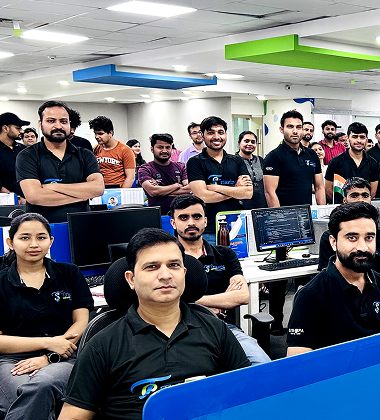
Triazine team
15,000+ concurrent users on AWS (Domino's)
2M+ Customers on an AWS platform we built (IGL)